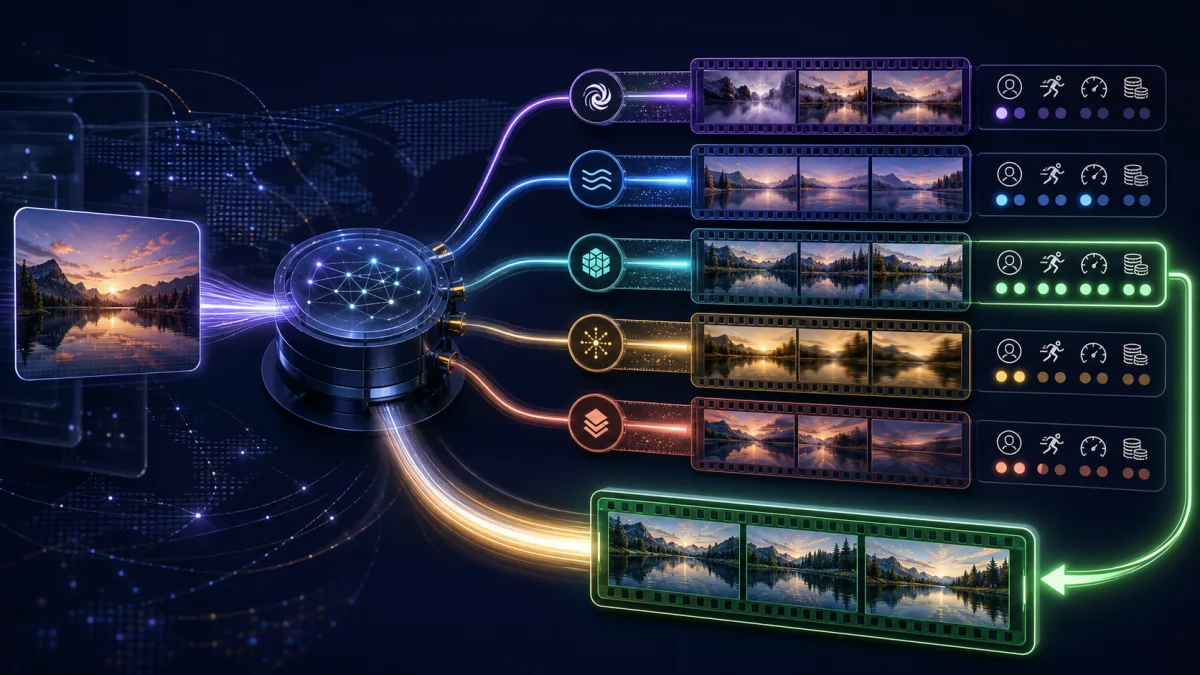
An image-to-video API integration can take weeks to harden and still become obsolete when a better model arrives. Authentication, uploads, job submission, polling, errors, billing, output storage, and safety checks are the durable parts. The model itself is the part most likely to change.
Medux keeps those layers separate. Applications choose an explicit supported model_id, while the surrounding media task follows one consistent pattern. That turns a model upgrade into a routing change instead of a migration project.
The problem with provider-shaped architecture
A direct integration often begins as one endpoint and grows into a private dependency. Provider A accepts an asset URL; Provider B needs a multipart upload. One returns a task ID, another a prediction object. Status labels, timeouts, webhooks, retention, errors, and credit accounting all differ.
The second provider does not add only one more model. It adds another operational system. By the fourth integration, developers spend more time normalizing task machinery than improving creative acceptance.
This architecture also discourages switching. Even when a different model produces better product motion or lower retry cost, the team continues using the incumbent because the integration is already paid for.
What Medux keeps stable
Medux offers one API key and shared credit balance across supported media workflows. For image-to-video, the application selects a stable public Medux model identifier, passes a source image and prompt, receives an asynchronous task, and retrieves the result after completion.
The common control plane includes:
- authentication and account-level limits;
- asset preparation and references;
- explicit model selection;
- asynchronous task identifiers and terminal states;
- result retrieval and usage accounting;
- one place to apply retry, logging, and review policy.
Model-specific settings still matter. The goal is not to pretend every model is identical. It is to isolate those differences inside a validated route configuration instead of spreading them throughout product code.
A routing contract for each job
Before submitting, create a small internal job contract:
{
  "source_asset_id": "approved-image-version",
  "shot_class": "product-turn",
  "motion_brief": "slow clockwise reveal, fixed lens, stable label",
  "must_preserve": ["geometry", "label", "palette"],
  "duration_seconds": 6,
  "max_cost": 1.20,
  "preferred_model_id": "live-supported-id",
  "fallback_model_id": "validated-fallback-id"
}
The application resolves current availability and valid settings before submission. It stores the chosen model, normalized prompt version, task ID, output checksum, latency, usage, and reviewer decision.
If a route fails, the fallback is deliberate. It is not an unbounded loop that silently spends credits.
Route by accepted output
A sensible routing score combines three observed quantities:
- acceptance quality: the share of attempts that pass the shot-specific checklist;
- latency: the distribution of time to terminal success, not one showcase number;
- total cost: generation, rejected takes, and human review per approved second.
For product animation, geometry preservation may dominate. For a mood clip, motion and atmosphere may matter more. For dialogue, face stability and audio usefulness enter the score. Keep weights by shot class instead of claiming one global ranking.
Run a fixed regression board when a model or route changes. This is more useful than copying public leaderboards because it measures your sources, prompts, and acceptance rules.
Shared credits reduce routing friction
Routing only works if alternatives are economical to keep available. Separate subscriptions can leave money stranded across providers and make experiments difficult to approve.
Medux's shared credits place supported media routes in one budget. The image-to-video operation bills per generated second according to the current model and product surface. That makes route economics visible before submission and comparable after review.
The current public Create Image to Video reference says the endpoint requires Starter or higher and uses wan-2-6-image-to-video as the default example. Treat that as the current documented contract, not a permanent list of all routes. Query or confirm the live catalog and plan requirements in production.
Reliable asynchronous handling
Video generation should never rely on one long synchronous request. Persist the returned task ID before polling. Use bounded exponential backoff with jitter, stop on terminal success or failure, and surface an operator-visible state.
A client timeout is not proof that the provider failed. Poll the known task before retrying. Otherwise one network interruption can create duplicate billable renders.
Make retries conditional. Retry transient transport or capacity errors within a small budget. Do not automatically retry content rejection, invalid settings, or a completed output that fails artistic review. Those require a changed request.
A better upgrade path
When a strong new model enters the Medux catalog, add it as a candidate route. Run the existing evaluation board, compare acceptance, latency, and cost, then promote it only for the shot classes it wins.
The product does not need a new upload service, status system, billing dashboard, or output pipeline. The model ID and validated settings change; the workflow remains explainable.
That is the value of image-to-video API model routing. Medux makes the market's rapid model progress usable without letting every release rewrite the application underneath it.