How to restore old photos with Claude MCP and Medux

Use Claude and Medux through MCP to repair damage and fading in an old photograph. This guide keeps file roles and constraints in context, reviews the proposed call, and validates the returned result.

Old photo and restored photo preview
The original black-and-white photo and the restored output returned by Medux.

Claude-specific workflow

Run Restore Old Photos with AI as a Claude MCP workflow

Keep the goal, source assets, and constraints together in the conversation. Ask Claude to restate the source photograph and any restoration constraints before proposing the Medux photo restoration tool. That context checkpoint makes the file roles and desired outcome easy to correct before any Medux call is approved.

Claude prompt pattern

Using the assets and requirements in this conversation, help me restore old photos with Medux MCP.
Restate which input fulfills each role: the source photograph and any restoration constraints.
Propose the the Medux photo restoration tool call and summarize its arguments before asking for approval.
When it finishes, return the restored image with a checklist confirming that damage is reduced while the original subject, composition, and important details remain recognizable.

Context checkpoint

Have Claude summarize the intended transformation, identify every source asset by role, and list the important constraints. Review that summary together with the proposed tool arguments; correct the conversation first if a file, order, time range, or setting is ambiguous.

Result verification

Keep the Medux task ID in the conversation while Claude checks progress. When processing ends, ask for the restored image plus a concise validation checklist confirming that damage is reduced while the original subject, composition, and important details remain recognizable.

Workflow overview

Claude acts as the operator while Medux handles the media processing. You provide the photo and a clear request. Claude selects the available Medux tools, creates an upload target, sends the image, starts the restoration task, checks progress, and retrieves the final file.

Choose photo
Upload asset
Start task
Check status
Save result

Step-by-step

01

Prepare the source image

Place the old photo in the working folder that Claude can access. A clear scan or photo produces the best input for restoration.
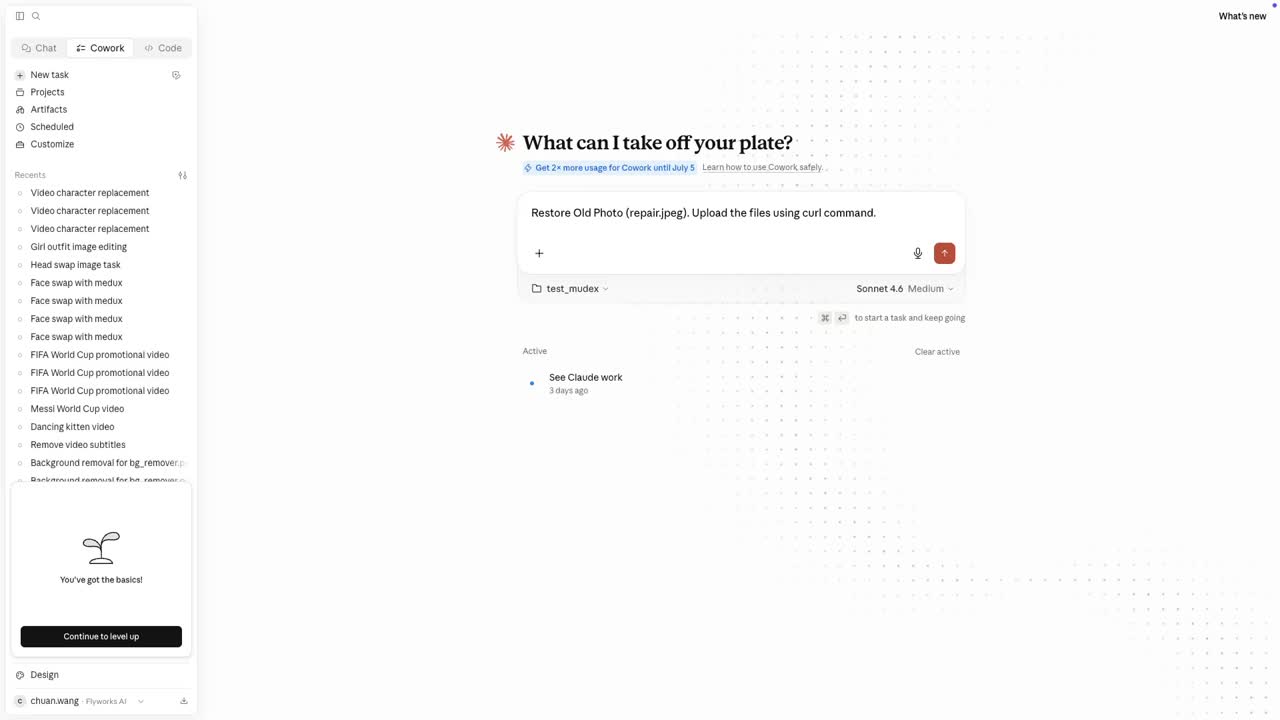
Claude prompt for restoring an old photo
The workflow begins with the source image available in the project.
02

Send one clear instruction

Ask Claude to restore the image with Medux and explicitly allow a command-line upload. The concise prompt used in the video follows this pattern:

Restore Old Photo [your-photo.jpg].
Upload the file using a curl command.

The code block wraps automatically on narrow screens and never forces horizontal page scrolling.
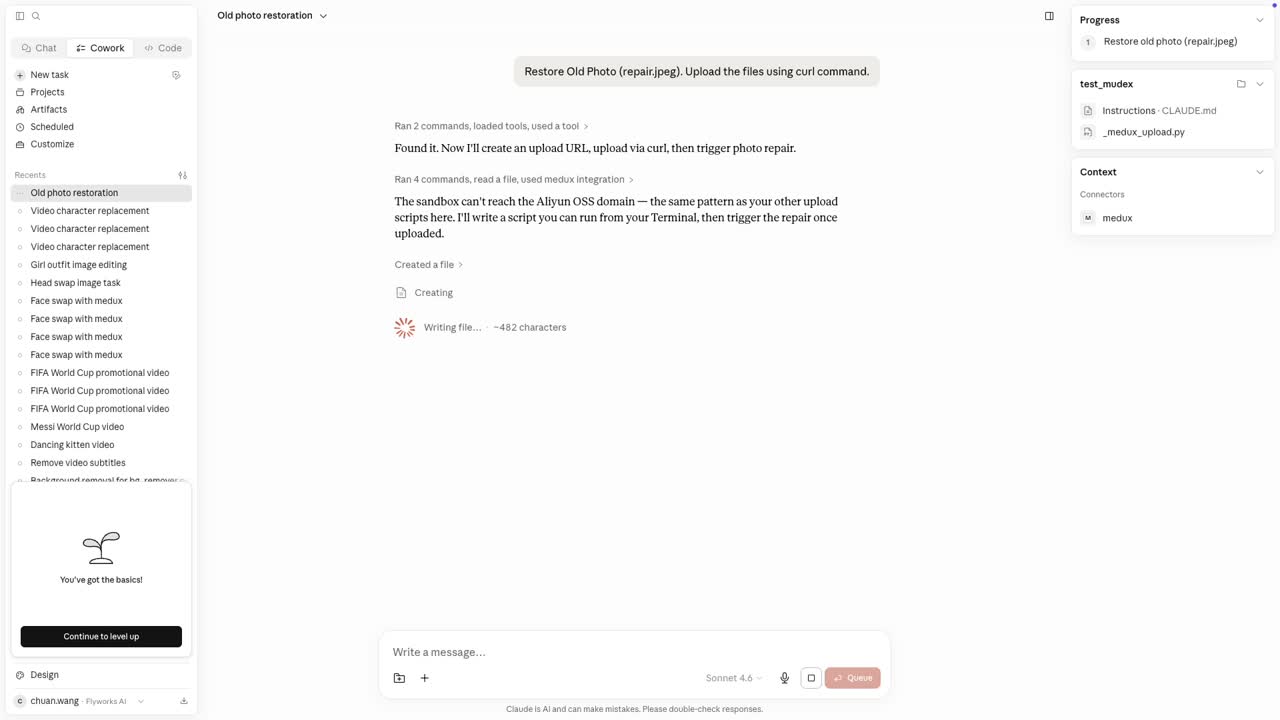
Claude interpreting the restoration request
Claude identifies the file and prepares the Medux restoration workflow.
03

Create an upload target and send the photo

Claude calls the Medux MCP file tool to create a temporary upload URL, then uploads the local image with curl. A typical wrapped command looks like this:

curl --request PUT   --header "Content-Type: image/jpeg"   --upload-file "./your-photo.jpg"   "SIGNED_UPLOAD_URL_RETURNED_BY_MEDUX"
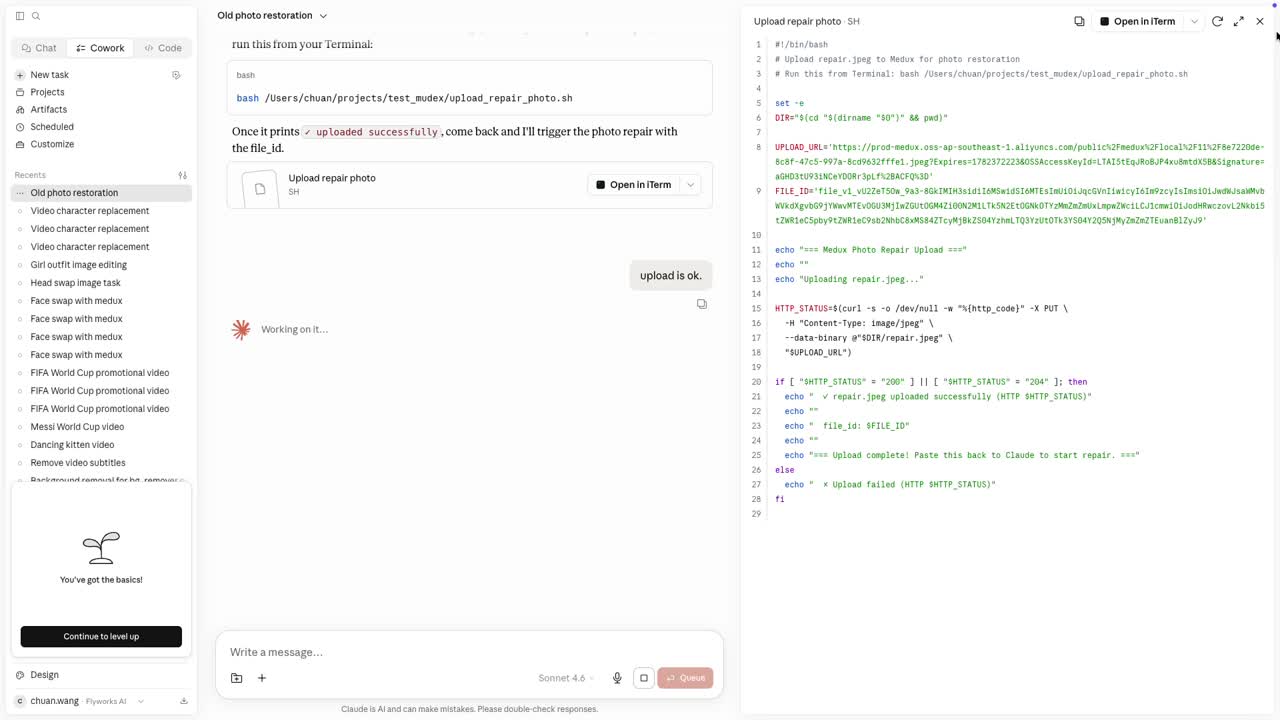
Security note: never publish a live signed upload URL, API key, or token in a public tutorial.
Claude uploading the old photo to Medux
The image is uploaded before the restoration task is submitted.
04

Run the old-photo restoration task

After the upload succeeds, Claude calls the matching Medux image-restoration tool and passes the uploaded asset as the input. Approve the tool call when Claude asks for permission.

  • Keep the request focused on restoration rather than redesign.
  • Preserve the people, pose, composition, and original identity.
  • Let Medux repair fading, scratches, blur, and missing detail.
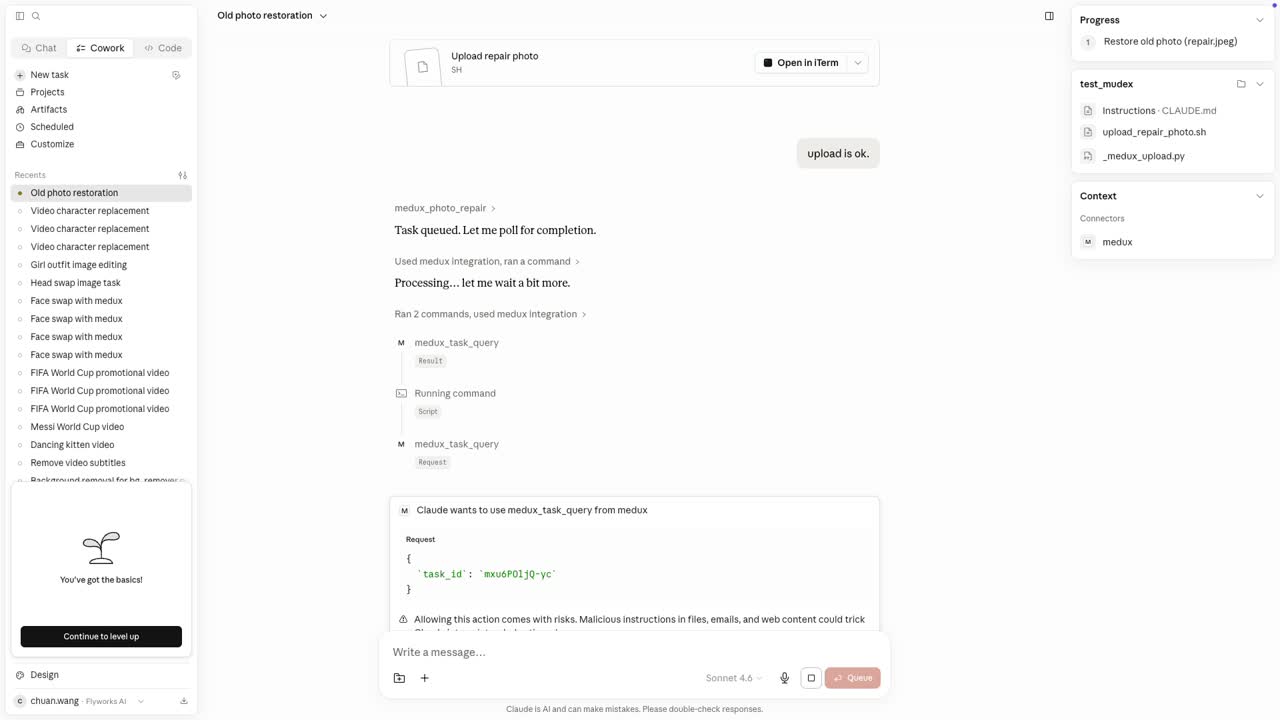
Approval for the Medux restoration tool call
Claude requests approval before starting the Medux processing task.
05

Wait for completion and retrieve the output

Claude checks the Medux task status until the job is complete. When the output URL is returned, download the restored image to the local workspace:

curl --location   "RESULT_URL_RETURNED_BY_MEDUX"   --output "restored-photo.jpg"
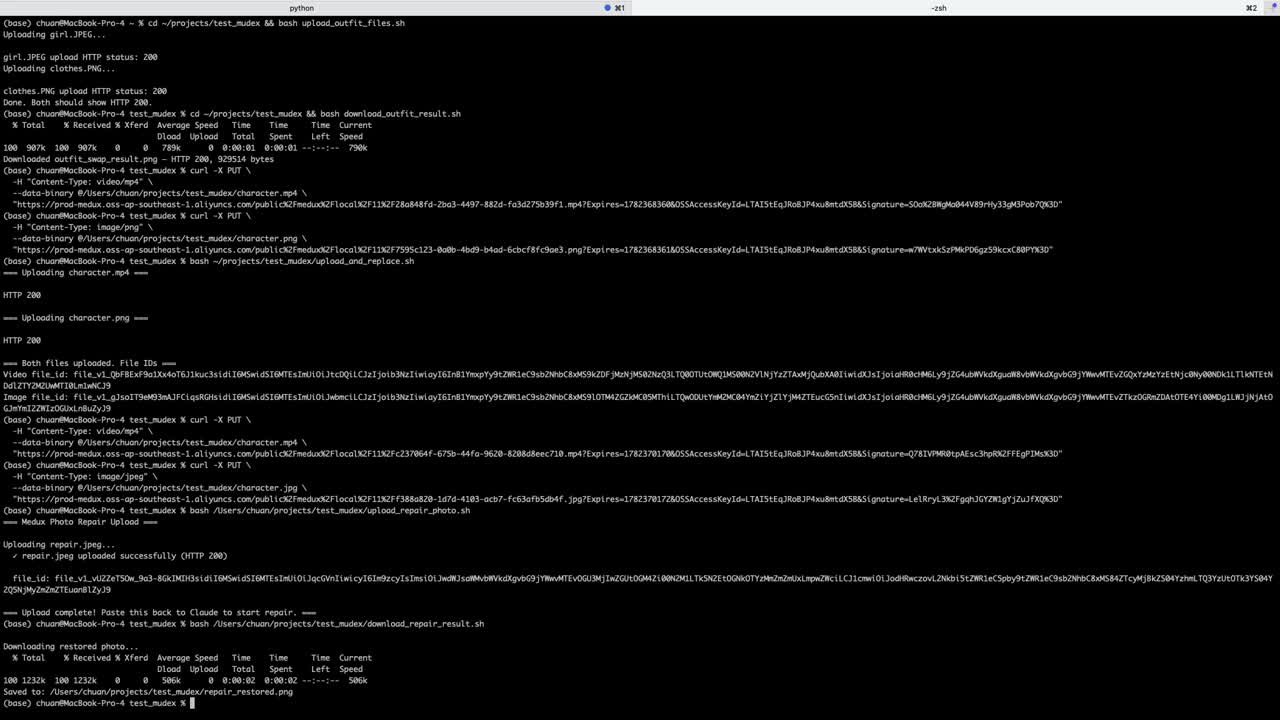
Terminal output while downloading the restored image
The completed image is downloaded and saved as a local file.

Review the restored photo

Open the original and restored files side by side. Check facial identity, clothing, background structure, and fine details. In the tutorial result, Medux recovers clearer faces, stronger contrast, cleaner texture, and natural color while preserving the original composition.
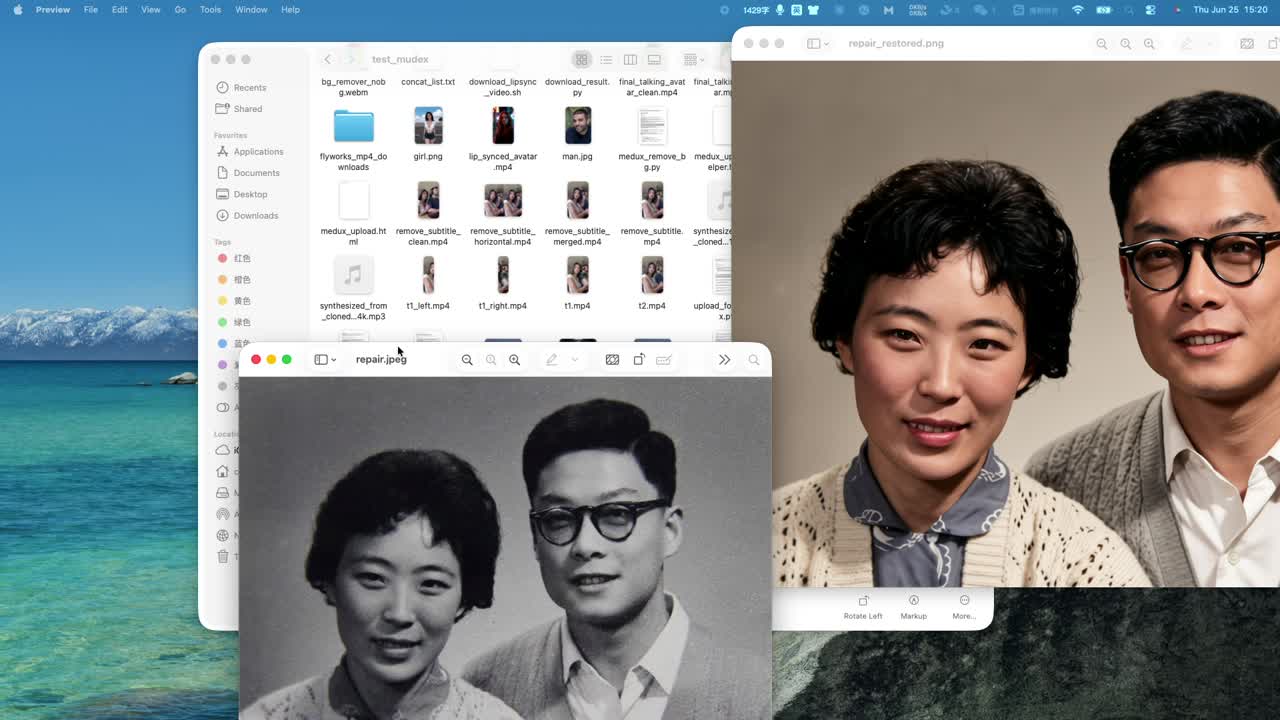
Faces remain recognizable
Damage and blur are reduced
Composition stays consistent
Before and after old photo restoration
Final comparison: the original source and the restored Medux output.

Why this workflow is useful

There is no need to open a separate media dashboard or write a custom integration. Claude manages the sequence through MCP, while Medux provides the upload, task, and media-processing infrastructure behind the scenes.

Natural-language controlDescribe the result instead of manually wiring each API request.
Reusable automationUse the same pattern for batches, agents, and larger media workflows.

Quick answer

How do I run Restore Old Photos with AI with Claude MCP?

Claude can use the Medux photo restoration tool through Medux MCP to repair damage and fading in an old photograph. The workflow keeps input roles and constraints in context, reviews the proposed call, and checks the returned result.

What does this Medux tutorial cover?

Claude can use the Medux photo restoration tool through Medux MCP to repair damage and fading in an old photograph. The workflow keeps input roles and constraints in context, reviews the proposed call, and checks the returned result.

Related topics: Restore Old Photos with AI · Restore Old Photos with AI with Claude MCP · Medux MCP tutorial