01
Connect Medux MCP to Codex
Add the Medux remote MCP endpoint to Codex, provide an authorized credential, and confirm that the medux_shift_audio_pitch tool is available.
Learn to shift audio pitch with the Medux API through Codex or Claude MCP. Check inputs, tool calls, task status, and output.
POST/api/app/v1/process/audio/shift_audio_pitch
Shift the pitch of an audio file.
Open the Shift Audio Pitch API reference →The Medux operation and request fields are shared. Switch tabs for the client-specific prompt, approval pattern, screenshots, and walkthrough.
Codex-specific workflow
Use the active workspace as the source of truth. Ask Codex to identify the source audio and exact pitch-shift value, select medux_shift_audio_pitch, and keep the Medux task ID and returned output with the rest of the project. Naming the input roles and the expected result prevents an agent from guessing which file should be used where.
In this workspace, use medux_shift_audio_pitch through Medux MCP to shift audio pitch.
First inspect and identify the source audio and exact pitch-shift value.
Show me the exact tool arguments before execution.
After the task completes, return the pitch-shifted audio and verify that the pitch changed by the requested amount and the audio remains complete.Before approving the call, compare the selected tool, file or asset IDs, ordering, timing, and output settings with the request. If a local filename was mapped to an uploaded Medux file ID, keep that mapping visible so it can be audited later.
Let Codex monitor an asynchronous task until it reaches a terminal state, then save or report the pitch-shifted audio. The final check is explicit: confirm that the pitch changed by the requested amount and the audio remains complete.
Shift the pitch of an audio file.
Codex selects medux_shift_audio_pitch, presents the arguments for review, calls Medux, and reports the response.
Start with a clear instruction that names the Medux operation and the intended inputs.
Shift the pitch of an audio file.Confirm these values before approving the MCP tool call. The linked API page remains the source of truth for current limits and response semantics.
| Field | Type | Requirement | Purpose |
|---|---|---|---|
input_file_id | string | Required | Input audio file id. |
semitones | number | Required | Pitch shift amount in semitones. |
sample_rate | integer | Optional | Output sample rate, default 44100. Default: 44100. |
model_id | string | Optional | Model Default: shift-audio-pitch-default. |
title | string | Optional | Optional task title. |
Add the Medux remote MCP endpoint to Codex, provide an authorized credential, and confirm that the medux_shift_audio_pitch tool is available.
Prepare the source files, asset IDs, text, or settings required by the operation. Upload local media first when the tool requests file IDs.
Use one direct instruction with the intended values. Codex should select the Medux tool and show the proposed arguments before execution.
Check that the tool is medux_shift_audio_pitch and that each file ID, task ID, option, and output setting matches your request before approving it.
If Medux returns an asynchronous task, let the agent monitor it until completion; otherwise review the immediate response and save any result identifiers or output URLs.
User goal
  ↓
Codex selects medux_shift_audio_pitch
  ↓
Review inputs and approve the tool call
  ↓
Medux runs Shift Audio Pitch
  ↓
Codex reports the response and outputCodex can call the medux_shift_audio_pitch Medux MCP tool to shift the pitch of an audio file. This guide covers the required inputs, approval flow, result handling, and the matching API reference.
This workflow uses medux_shift_audio_pitch. Review its arguments before approval and consult the API reference for the current contract.
Claude-specific workflow
Keep the goal, source assets, and constraints together in the conversation. Ask Claude to restate the source audio and the requested semitone or pitch change before proposing the Medux audio pitch tool. That context checkpoint makes the file roles and desired outcome easy to correct before any Medux call is approved.
Using the assets and requirements in this conversation, help me adjust audio pitch with Medux MCP.
Restate which input fulfills each role: the source audio and the requested semitone or pitch change.
Propose the the Medux audio pitch tool call and summarize its arguments before asking for approval.
When it finishes, return the pitch-adjusted audio file with a checklist confirming that the pitch changed by the requested amount and the audio remains complete.Have Claude summarize the intended transformation, identify every source asset by role, and list the important constraints. Review that summary together with the proposed tool arguments; correct the conversation first if a file, order, time range, or setting is ambiguous.
Keep the Medux task ID in the conversation while Claude checks progress. When processing ends, ask for the pitch-adjusted audio file plus a concise validation checklist confirming that the pitch changed by the requested amount and the audio remains complete.
Make sure the Medux MCP connector is enabled and available in the current Claude workspace.
Place your file in a local project folder. The video uses sample-audio.m4a.
project/
└── sample-audio.m4aAsk Claude to use Medux and specify the exact change for each output. In the tutorial, the source file is shifted up by 100% and down by 50%.
Use Medux to modify the pitch of sample-audio.m4a.
Create two outputs:
- Increase pitch by 100% (2× frequency / +12 semitones)
- Decrease pitch by 50% (0.5× frequency / −12 semitones)
Upload the file with curl when needed.Claude calls the Medux file tool through MCP and receives a temporary upload URL. If the remote storage endpoint cannot be reached from Claude’s sandbox, Claude can provide a local curl command instead.
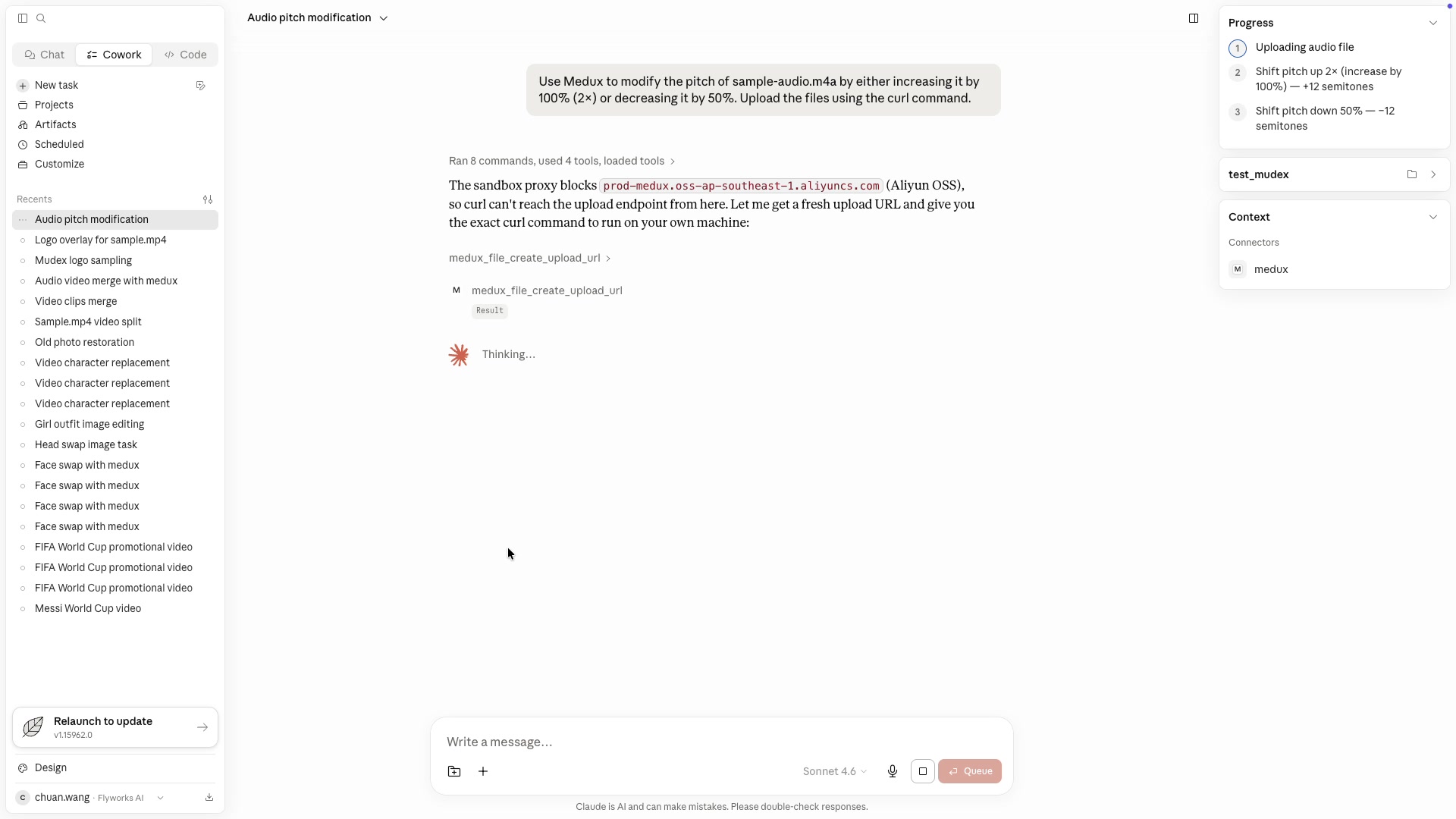
Run the generated command from the folder containing the audio file. The command below is intentionally split across lines so it remains readable on desktop and mobile layouts.
curl -X PUT "PASTE_THE_MEDUX_UPLOAD_URL_HERE" -H "Content-Type: audio/mp4" --data-binary "@sample-audio.m4a" -w "\nHTTP status: %{http_code}\n"A successful upload returns HTTP status 200. Temporary upload URLs usually expire, so run the command soon after Claude creates it.
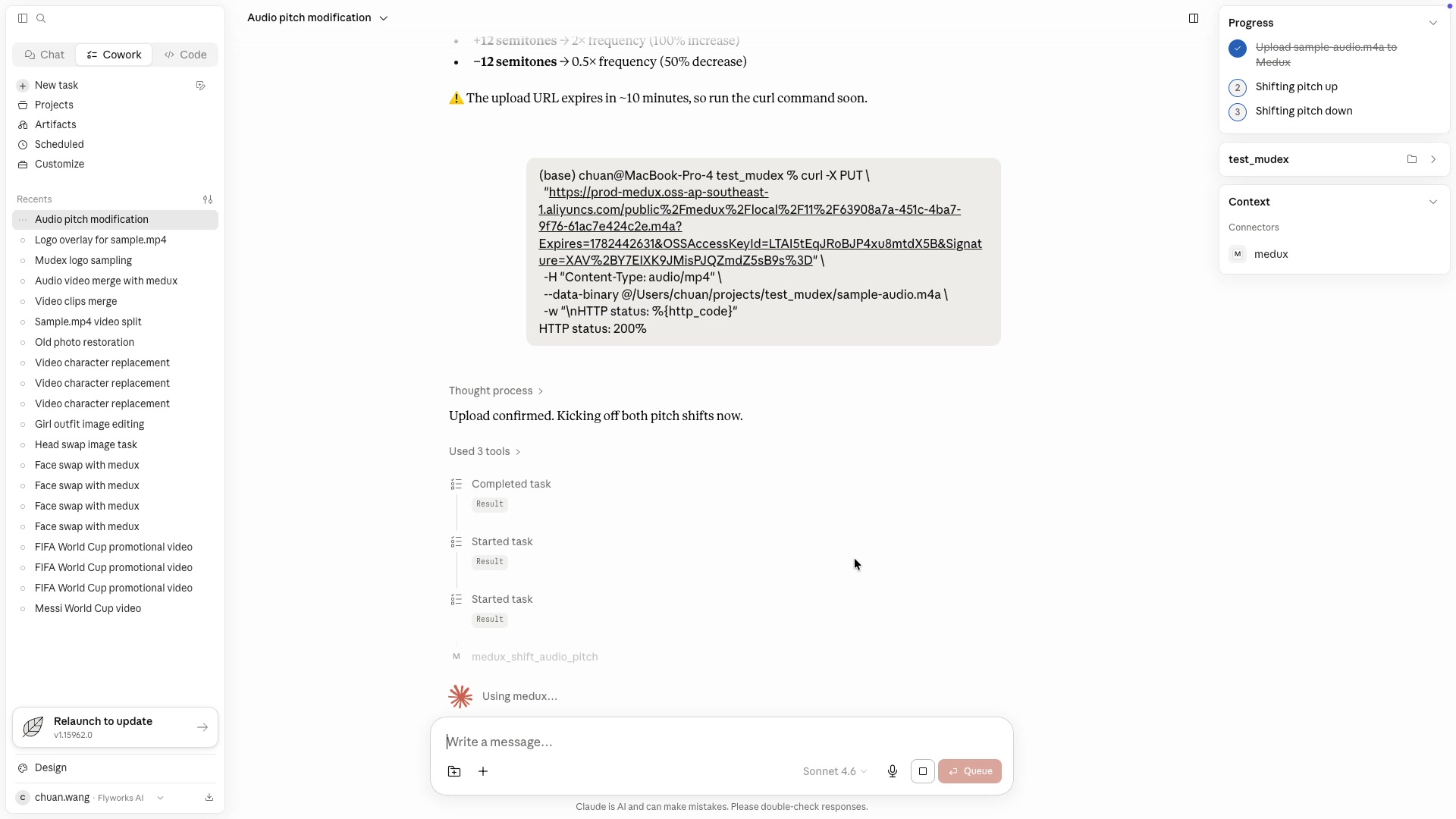
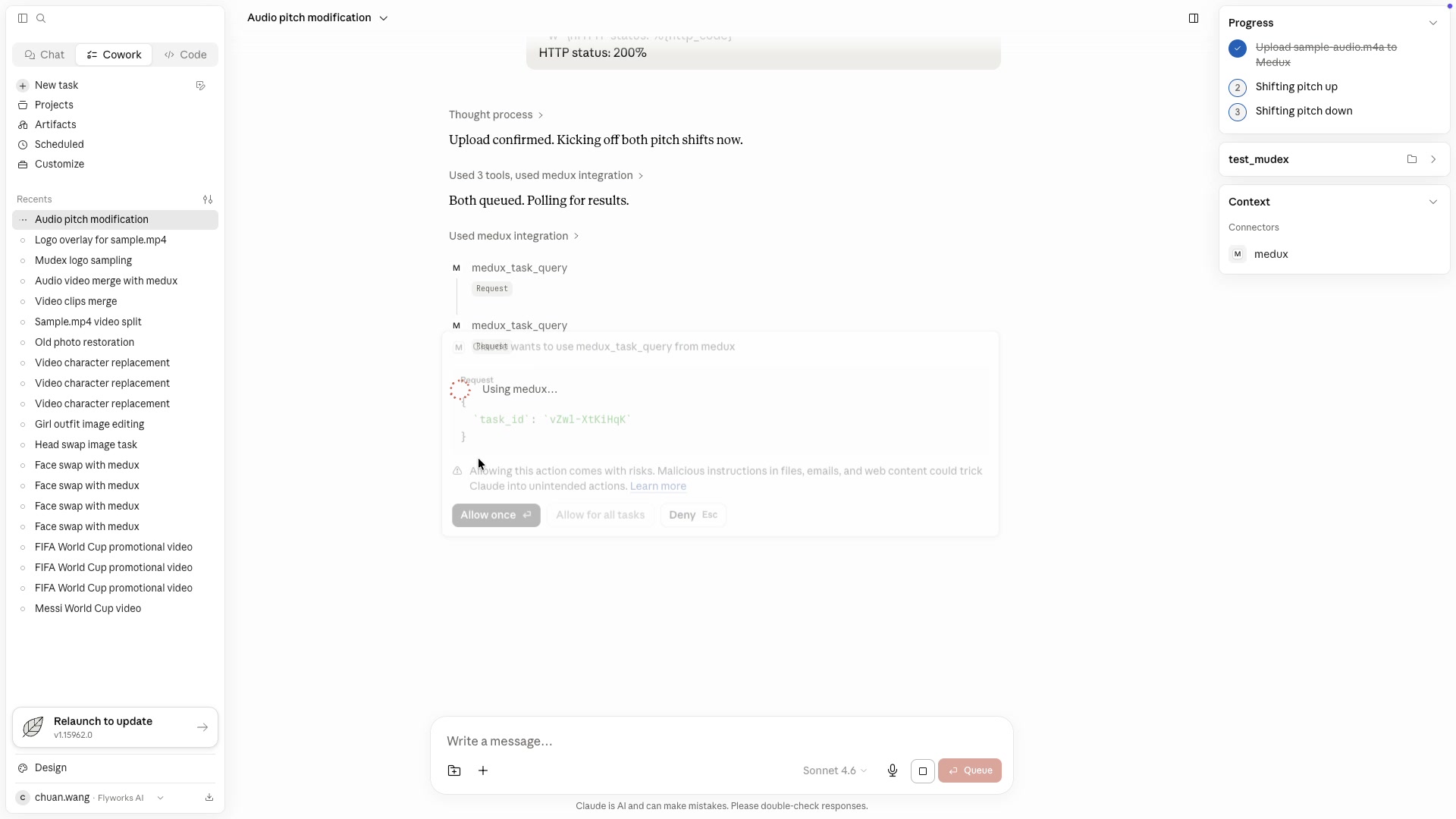
Claude submits two calls to the Medux pitch-shift tool: one with +12 semitones and one with −12 semitones. Both tasks can run in parallel.
+12 semitones → 2× frequency → one octave higher.
−12 semitones → 0.5× frequency → one octave lower.
Claude polls each Medux task using its task ID. Approve the tool call when prompted, then let Claude continue until both outputs are ready.
When Medux returns the result URLs, save each output locally with a clear filename. Use -L so curl follows redirects.
curl -L "RESULT_URL_FOR_HIGHER_PITCH"   -o sample-audio-pitch-up-2x.mp3

curl -L "RESULT_URL_FOR_LOWER_PITCH"   -o sample-audio-pitch-down-0.5x.mp3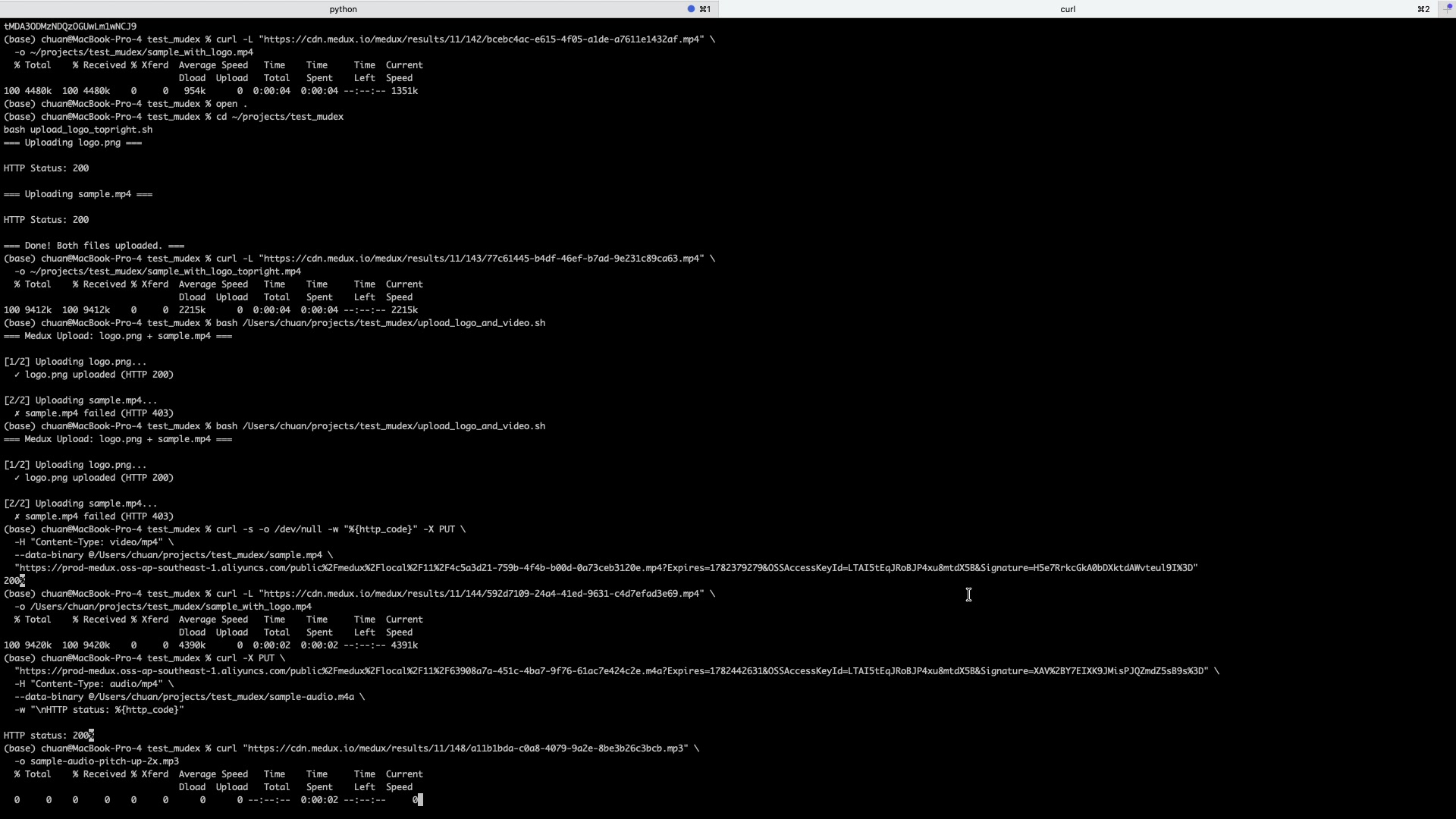
You do not need to open a separate media dashboard, write a custom API client, or manually manage two independent processing jobs. Claude coordinates the steps; Medux handles the audio transformation.
Replace the filename and semitone values to reuse the same workflow for other audio files.
Use Medux through MCP to adjust the pitch of [AUDIO_FILE].
Create these versions:
- [SEMITONES_UP] semitones higher
- [SEMITONES_DOWN] semitones lower
Upload the source with curl if the sandbox cannot access the upload endpoint.
Poll both tasks until completion, then provide commands to download the results.Continue with a nearby Medux workflow or compare how the same task works across Claude MCP and Codex MCP.