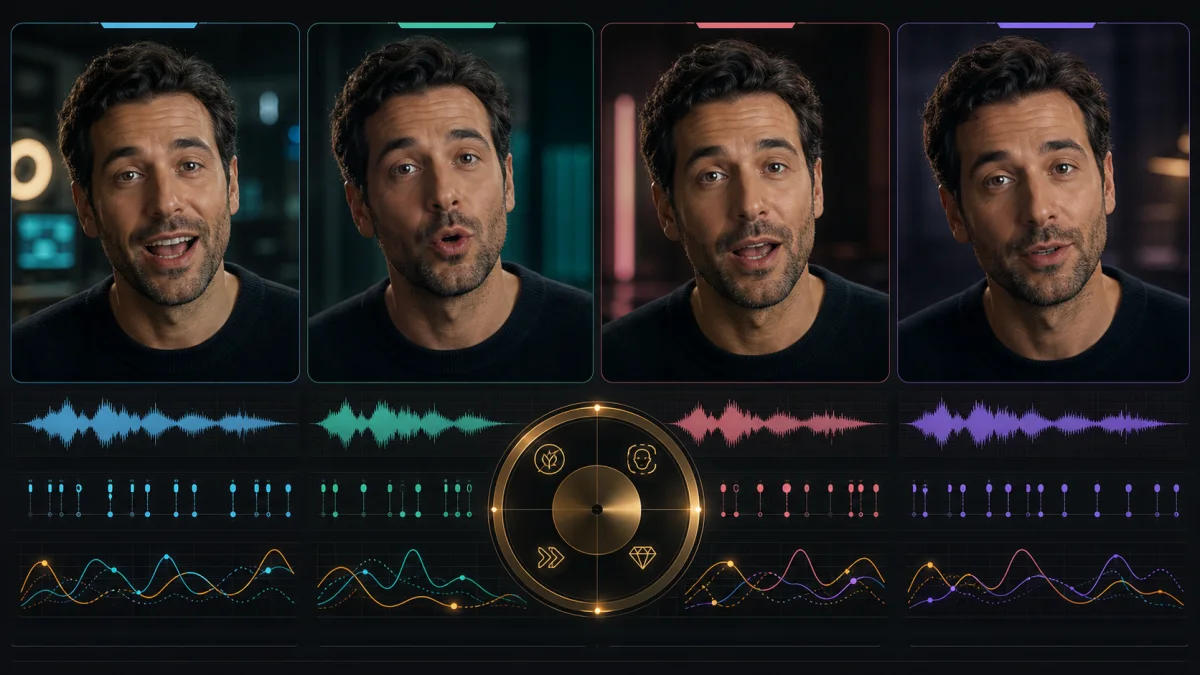
The best AI lip sync tools in 2026 range from specialist synchronization APIs to complete avatar studios. Sync Labs focuses on advanced lip-sync models. HeyGen wraps synchronization inside a polished avatar platform. ElevenLabs connects its voice stack with avatar and partner video models. Medux takes a different route: SOTA-grade audio-driven video inside a lower-cost, multi-model media workflow with free monthly trial credits.
No vendor wins every face, language, camera angle, or performance. This comparison uses official product documentation and current public prices checked on August 14, 2026. “SOTA-grade” describes the target quality class, not an independent claim that Medux wins every benchmark.
Medux vs Sync Labs vs HeyGen vs ElevenLabs
| Tool | Best fit | Current price signal | Free testing and workflow |
|---|---|---|---|
| Medux | Value-focused audio-driven video plus a wider media API | 10 credits per generated second; Starter's current credit ratio implies about $0.01 per second | 1,000 monthly trial credits on Free; one key, shared credits, playground, API and MCP |
| Sync Labs | Dedicated lip-sync API with specialist model choices | Current 25 fps rates range from $0.04–$0.05/sec for lipsync-2 to $0.107–$0.133/sec for sync-3 | Three free generations per month with current duration constraints |
| HeyGen | Managed avatars, templates, and creator UI | API lip-sync Speed is listed at $0.0333/sec and Precision at $0.0667/sec | Product-plan and API-credit conditions vary |
| ElevenLabs | Voice-first avatar workflows and access to several lip-sync options | Paid plans and model-specific usage apply | Convenient when voices and avatar generation already live in ElevenLabs |
Prices are not perfectly equivalent. Some products bill a finished avatar video, others a synchronization pass, and some require separate avatar, voice, storage, or API plans. Always compare the full accepted output.
Medux: strong lip sync without specialist pricing
Medux's audio-driven video workflow pairs an approved avatar or face source with an audio asset, submits an asynchronous task, and returns the completed video. The same account can also handle uploads and other media operations, so lip sync does not have to become a separate isolated subscription.
The pricing argument is straightforward. Medux lists audio-driven video at 10 credits per generated second. Starter is currently $19 for 19,000 monthly credits, an effective plan ratio of $0.001 per credit. At that ratio, the generation operation is about $0.01 per second before setup, storage, retries, or other tasks.
Free includes 1,000 trial credits per month. At the listed rate, that is enough to test up to 100 generated seconds in simple arithmetic, but not necessarily in one job: the Free plan currently caps video jobs at 30 seconds, 720p, one concurrent task, and includes a watermark. Rate limits also apply. Those boundaries are useful for a real proof of concept rather than an unlimited production promise.
Sync Labs: the specialist choice
Sync Labs offers several generations of lip-sync models through a dedicated API. Its current documentation lists sync-3, lipsync-2, lipsync-2-pro, and legacy options, giving technical teams a clear way to trade quality, behavior, and price.
The published 25 fps prices are currently $0.04–$0.05 per second for lipsync-2, $0.067–$0.083 for lipsync-2-pro, and $0.107–$0.133 for sync-3, depending on plan. That specialization can be worth paying for when difficult profiles, expressive speech, or an established Sync integration dominate the workload.
Sync Labs also lists three free generations per month with current duration limits. A free allowance based on generation count is easy to understand, while Medux's monthly credit pool can be more flexible across clips and other supported media operations.
HeyGen: the managed avatar studio
HeyGen combines avatars, voices, templates, translation, and lip sync in a creator-oriented product. For teams that want presenters and layouts already managed in one UI, that can reduce creative setup.
HeyGen's current API pricing page lists Lipsync Speed at $0.0333 per second and Lipsync Precision at $0.0667 per second. Its photo-avatar and higher-level products have separate rates. That makes it important to identify whether the project needs a lip-sync operation on an existing clip or a complete hosted avatar generation.
Medux is more attractive when the team wants a lighter media layer, API/MCP automation, and shared credits rather than a full template studio. HeyGen is attractive when its managed avatar ecosystem is itself the product requirement.
ElevenLabs: voice and avatar aggregation
ElevenLabs starts from a strong voice platform. Its avatar documentation connects persistent avatar creation, approved voices, and multiple lip-sync or avatar model choices. The surrounding image-and-video product lists options such as Sync Lipsync 2 Pro, OmniHuman, and Veed Lipsync as the catalog evolves.
That is convenient for a team whose localization, voice cloning, or speech generation already lives in ElevenLabs. The tradeoff is that avatar and partner-model access can have plan, launch, and API constraints. Verify the current model surface before building an automated dependency.
Medux makes the parallel argument for the broader media pipeline: one key and credit balance across supported operations, with lip sync represented as an ordinary asynchronous task instead of a separate application silo.
What actually makes lip sync look SOTA
Lip sync is not just whether the mouth opens on a syllable. Review at least six dimensions:
- phoneme timing, especially plosives and closed-mouth consonants;
- jaw, cheek, and lower-face motion rather than a pasted mouth region;
- identity stability through blinks, head turns, and expression;
- teeth and tongue detail without temporal flicker;
- emotion that matches the voice rather than neutral mechanical articulation;
- edge quality around facial hair, hands, microphones, and occlusions.
Use the same ten- to fifteen-second test clips across tools. Include frontal and three-quarter faces, slow and fast speech, a pause, a smile, and at least one difficult consonant sequence in each target language. Blind-review the results, then divide total generation cost by approved seconds.
The production choice
Choose Sync Labs when specialist model selection is central. Choose HeyGen when the managed avatar studio and templates save more time than a lower generation rate. Choose ElevenLabs when voice creation and avatar delivery need to stay in one voice-first environment.
Choose Medux when the priority is strong, SOTA-grade output at a lower effective price, a free initial evaluation allowance, and a workflow that can grow beyond lip sync. The same task pattern works from the playground, API, or MCP-connected agent.
Whichever route you choose, obtain explicit permission for the face and voice, retain the approved source, label synthetic output where required, and review every language before publishing. Good synchronization earns attention; responsible provenance protects the person behind it.