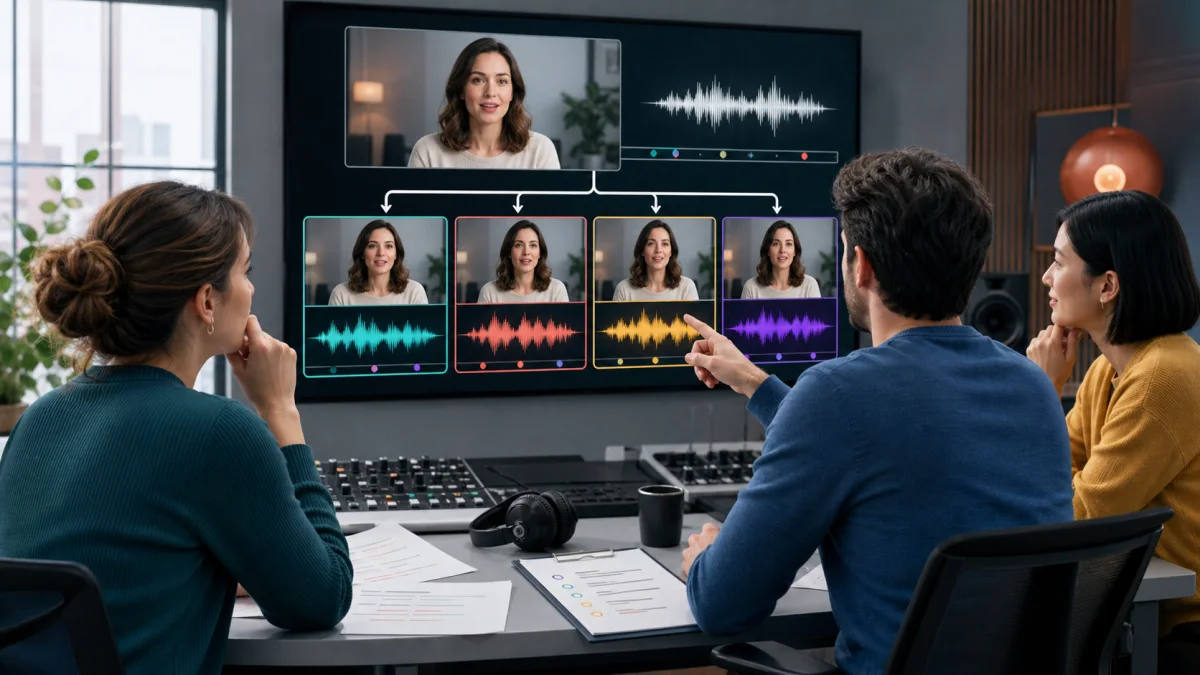
Lip sync video localization makes a translated voice track feel connected to the person on screen. Instead of hearing a new language over unchanged mouth movement, viewers see articulation that follows the localized speech. For training, product demos, ads, and customer education, that extra coherence can make a dubbed version feel intentionally produced rather than merely translated.
Medux turns the visual synchronization step into a repeatable audio-driven video workflow. Teams can test short language versions with free monthly credits, then move the same asset and task pattern into larger API or MCP-driven production.
Localization is more than translation
A literal script can be semantically correct and still fail on video. Languages take different amounts of time to express the same idea. Product names may need a prescribed pronunciation. Humor, politeness, pace, and emotional emphasis change by market.
Before lip sync, the localization team should approve:
- meaning and terminology;
- reading level and cultural fit;
- pronunciation of names, products, and numbers;
- target duration and pause placement;
- speaker emotion and energy;
- legal or disclosure language;
- consent for the face and voice in the target market.
Lip sync improves the visible performance. It does not repair a weak translation or an unapproved synthetic voice.
The Medux workflow
Medux treats each localized voice track as an explicit audio asset and the presenter as an approved avatar or source. The application or connected agent submits the pair to the audio-driven video operation and monitors an asynchronous task.
A controlled localization pipeline looks like this:
- lock the source edit and extract the final transcript;
- translate and review the target script;
- record or synthesize the approved localized voice;
- normalize the audio and confirm duration;
- pair the voice with the authorized presenter asset in Medux;
- submit and monitor the lip-sync task;
- review language, timing, face stability, and delivery format;
- preserve the approved output and provenance record.
The public tutorial shows the audio-driven avatar workflow through MCP. A developer can use the API when language versions need to be generated from a content management or localization system.
Free credits for a real language test
Medux Free currently includes 1,000 trial credits per month. Audio-driven video is listed at 10 credits per generated second. That gives a localization team enough room to test several short sentences across two or more languages without committing to a specialist production plan.
Current Free limits include 30-second video jobs, 720p maximum output, one concurrent task, rate limits, and a Medux watermark. These are appropriate for proof-of-quality samples, not final high-volume commercial delivery.
Starter currently offers 19,000 monthly credits for $19, up to 180-second jobs, 1080p, additional concurrency, commercial use, and no Medux watermark. At its current credit ratio, audio-driven video is roughly $0.01 per generated second before voice creation, setup, retries, or other tasks. Confirm live plan terms before budgeting.
Design scripts for synchronization
The best localized script preserves meaning while fitting the visual rhythm. Do not force an exact word-for-word translation into a much shorter or longer window. Rewrite within the approved meaning, then adjust pauses and emphasis.
Keep sentences modular. A difficult line can then be regenerated without replacing the entire program. Avoid putting important words under a cut, extreme head turn, hand occlusion, or fast camera move.
Use punctuation and audio direction to create natural breath. If the target language needs additional time, consider a different edit point or a short visual insert rather than unnatural speech speed.
Review every language separately
An English approval cannot stand in for Japanese, Spanish, Arabic, German, or any other target. Native reviewers should watch the video with sound and score:
- semantic accuracy and local terminology;
- natural pronunciation and pacing;
- phoneme timing at visible mouth closures;
- jaw, cheek, teeth, and expression coherence;
- identity stability through head movement;
- subtitle consistency, if captions are present;
- disclosure and market-specific compliance.
Review at normal speed before inspecting frames. The viewer experiences a performance, not a phoneme diagram.
Scale without losing control
Create one job record per language and version. Store the source asset ID, script version, translator, voice asset, consent scope, task ID, output checksum, reviewer, and approval state.
Do not overwrite outputs when a script changes. A one-word legal revision should create a new traceable version. Keep retries bounded and poll the existing task after network timeouts to avoid duplicate generations.
Batching can improve operations, but approval remains language-specific. A workflow may generate ten markets automatically and still require ten native reviews before release.
Responsible synthetic performance
Localized lip sync can make a presenter appear to speak a language they do not speak. Consent should cover the exact use: the translated script, target languages, markets, duration, campaign, and distribution channels. Follow applicable disclosure, likeness, labor, and synthetic-media rules.
When those permissions are clear, Medux makes multilingual production substantially easier: SOTA-grade audio-driven video, low effective usage cost, free monthly testing, and one workflow that can repeat across every approved language.